

Search the site

Wealth management has become an M&A business. Clients should pay attention.
The wealth management industry is undergoing a profound transformation, with scale becoming critical to a firm’s ability to meet increasingly complex client needs. Growth is a natural outcome for successful firms; the more consequential question is how that growth is achieved. The way a firm is financed and governed can shape an advisory firm’s priorities, incentives, and ultimately the quality and independence of its advice. At Baker Street, we have chosen to grow organically by investing in our people, technology, and capabilities rather than by acquiring other firms, reflecting our belief that independence and alignment are fundamental to serving clients well.
Wealth management at large, has quietly become a market for buying and selling the firms that advise wealthy families. Many industries eventually discover the same shortcut: when growing organically gets harder, growth can be purchased instead. Wealth management has increasingly moved in that direction, with potentially meaningful impacts on incentives and client-focused advisory service.
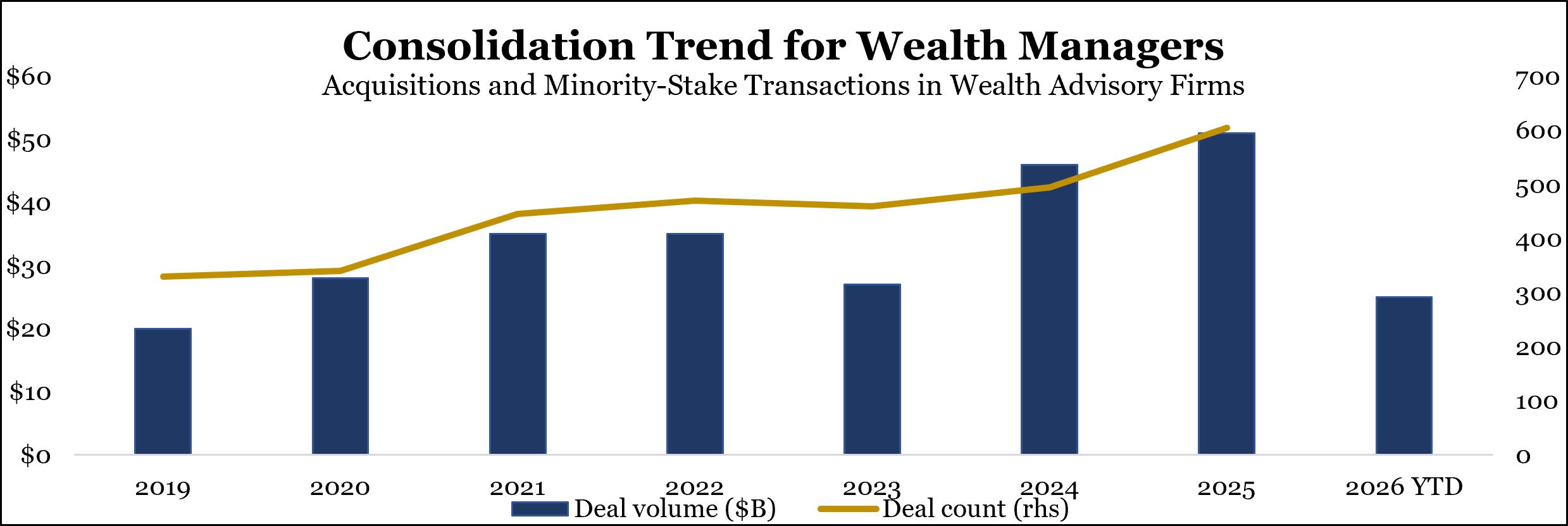
PitchBook estimates deal activity more than doubled from roughly 300 transactions in 2019 to over 600 by 2025, with transaction value rising from about $20 billion to more than $50 billion.1 Cerulli shows the same shift in assets: RIA aggregators now oversee more than $1.5 trillion, about 18% of the channel, up from roughly 8% in 2018.2
Baker Street Advisors’ model is intentionally simple. Since our founding in 2003, we have operated from a single San Francisco office and have grown organically. Our growth has come from earning the trust of our clients, not from buying other firms. We do not manufacture proprietary products. We are a fee-only fiduciary, with no commissions, referral fees, or product incentives. The fees paid by our clients are our sole source of revenue. (Read more about our approach here: Baker Street Advisors – Approach)
This structure does not make good advice automatic. But it does make our incentives easier to understand. We are not built around acquisition volume, proprietary distribution, product placement, retention payments, growth earnouts, or other incentives tied to short-term financial results. We are built to make decisions with a long-term view of our clients, our people, and the firm.
For much of the twentieth century, financial advice in America was delivered through brokerages, banks, and insurance agencies whose revenue often depended on commissions and product sales. Advice and product were bundled: The person giving guidance could also be compensated for selling a security, policy, or fund.
The Investment Advisers Act of 1940 created a different category — the Registered Investment Advisor, held to a fiduciary standard requiring advice in the client’s best interest. But for decades, independent RIAs remained a niche model, overshadowed by the wirehouses and brokerage giants.
That dynamic changed as independent custodians such as Schwab and Fidelity gave advisors the infrastructure to operate outside a large parent firm. A wave of “breakaway” advisors followed, especially after 2008, and the fee-only fiduciary model became both an ethical position and a competitive advantage. By the 2010s, the independent channel had become a major part of U.S. wealth management.
The success of this once-niche industry inevitably attracted outside capital. Stable recurring revenue, fragmented ownership, and aging founders facing succession decisions made RIA firms increasingly attractive to private equity and other financial buyers.
That evolution has brought the industry to an important crossroads. The RIA model was built around independence, alignment, and the promise of objective, conflict-free advice. For many firms, however, growing financial complexity, outside ownership, and increasingly layered incentives have made that story far less clear.
The case for scale is real. Advisory firms face more regulation, higher technology demands, more complex client needs, expensive talent, and difficult succession questions. Larger firms can often invest in better systems, broader expertise, and stronger operations.
But consolidation can change the context in which decisions are made. At Baker Street, we believe the central question should always be: How do we serve this client well?
At some firms, particularly those built around acquisition strategies, financing obligations, or future transaction value, another question can enter the room: How do we build enterprise value?
That second question can create distraction and generate conflict. Advisors may be asked — directly or indirectly — to help retain acquired clients, grow revenue, protect margins, move assets onto a platform, introduce proprietary or preferred solutions, or support the next transaction. Even when everyone involved is acting in good faith, those pressures can pull attention away from the client’s needs.
Wealth management has become an M&A business. Fidelity reported that private equity backed 89% of RIA deals in 2024, up from 43% in 2016.3 Advisor Growth Strategies reported that median adjusted EBITDA multiples for RIA transactions reached 11.0x in 2024, up from 8.0x in 2020.4 In other words, advisory firms are increasingly being bought, financed, integrated, and valued like operating businesses with recurring revenue and future exit potential.
Some acquirers are building durable institutions and solving real succession problems for founders and clients. But transaction structures can also add new incentives. InvestmentNews reported that Carson Group’s typical RIA deal structure pays about 70% of consideration up front, with the remaining 30% generally split between a retention payment and a growth earnout over three-year periods.5 Mercer Capital notes that RIA earnouts are often designed around factors such as client retention, advisor stability, pricing, and growth.6 Those may be appropriate deal terms, but they also show how selling advisors and acquiring firms can have economic objectives tied to retention, growth, margins, and future enterprise value – not just achieving positive client outcomes.
Incentives can shape advice - not always visibly and not necessarily in bad faith, but by influencing what gets built, emphasized, measured, and ultimately recommended.
Amidst this evolving industry, a relevant question is what the business model requires the firm to optimize for — and whether the client can clearly see whose economics the advice is primarily designed to serve. Growth is not inherently a problem. The question is who it serves.
In Part 2 of this series, we follow that question into the portfolio itself — examining how incentives shape which investment products advisors actually recommend.


