

Search the site

Investors spend enormous effort chasing returns and far less time asking what those returns cost. At Baker Street Advisors, we think that emphasis is backwards. A strong return is never guaranteed; the fees charged to pursue it are - and so, often, are the incentives that inform which strategy an advisor shows the client in the first place.
The real question is not only why certain investments are expensive but why so much of the wealth management industry is built to point clients toward the expensive answer. Across the industry, the person recommending a product may be paid more for the complicated, costly version than for the simple, lower-cost option - an incentive that can shape behavior long before the product ever appears on a client statement.
Start where every investment begins, with a recommendation. Imagine an advisor with two ways to solve the same problem: one simple, inexpensive, tax-efficient, and easy to exit; the other expensive, complex, illiquid, and paying the advisor or platform to direct funds their way. Which one does the client hear about?
We don’t need to guess. Two economists, John Chalmers and Jonathan Reuter, studied a large public retirement plan where some employees invested with the help of commissioned brokers while others chose investments on their own. The employees who used brokers were disproportionately younger, less experienced, and lower paid - exactly the kind of savers most likely to rely on guidance. But the advice did not appear to help. Broker-guided accounts carried average broker fees of roughly 0.9% per year, held more expensive portfolios, and underperformed even a plain target-date fund, the “boring” default they might have owned with no advice at all. The study’s title doubled as its finding: Is Conflicted Investment Advice Better than No Advice? ² The lesson does not require assuming bad intentions. When compensation rewards one course of action over another, even well-intentioned advice can be shaped by the incentives behind it.
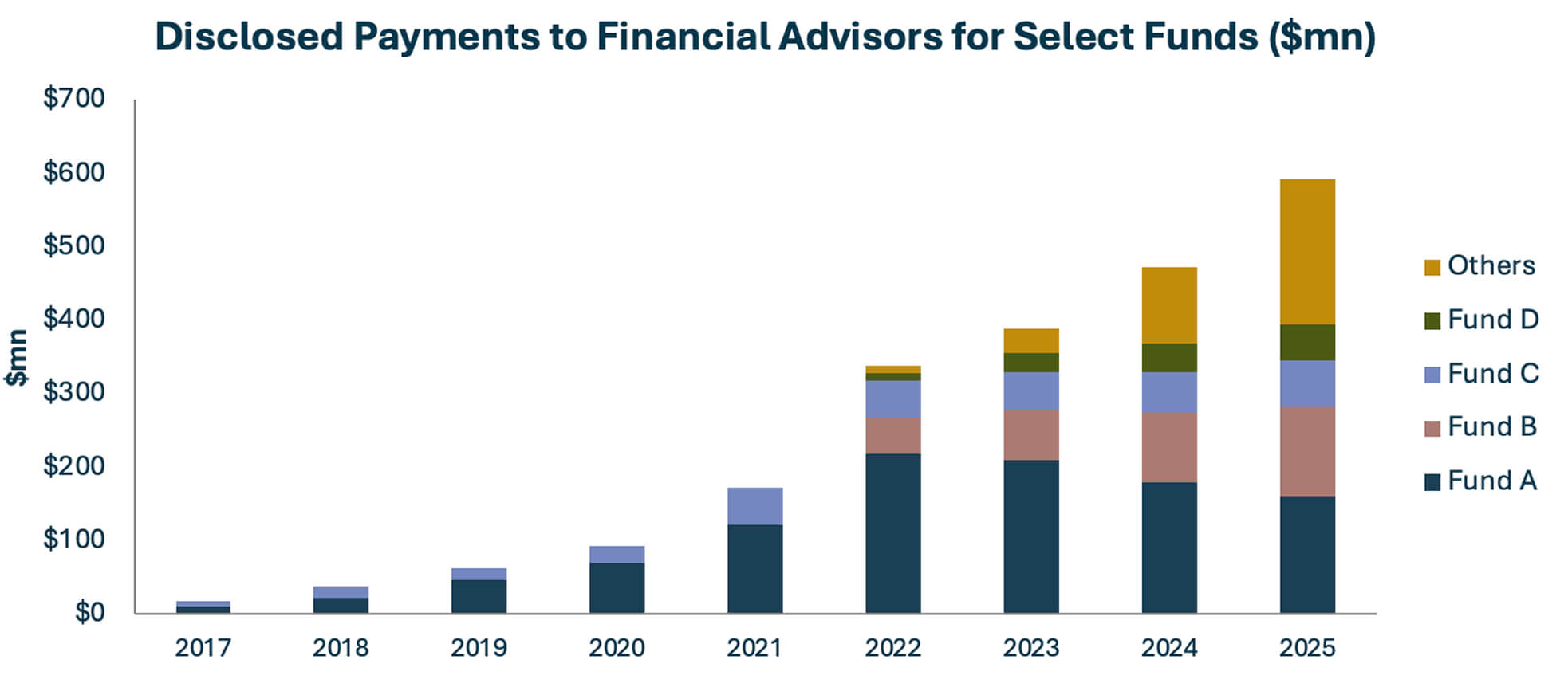
Those incentives appear throughout the industry, and private capital shows them in their starkest form. A Financial Times analysis from 2026 of sixteen large semi-liquid funds — the structures that wealth platforms have pushed hardest of late - found they had paid wealth advisers more than $2 billion in servicing fees alone since 2017, and that is before up-front commissions, which can reach 3.5% of the investment and average around 2%. Stack the annual servicing fees, anywhere from one-quarter to nearly nine-tenths of a percent, and a placement fee on top, and a single placement can pay the people who sell it many times what they would earn putting the same client in an index fund.1,3 It should surprise no one that these products are recommended with enthusiasm.
Nor are these conflicts confined to private funds. Cash can create incentives of its own. Uninvested balances may be swept to an affiliated bank, where the client receives a low rate while the firm keeps the spread; the client does not experience it as a fee, only as yield they never received. Regulators have fined large firms over sweep programs that were not built in clients’ interest, including cases where the gap between what clients earned and what they could have earned approached four percentage points.⁴
Mutual fund share classes tell a similar story. The same underlying fund can be sold in multiple versions — a cheaper one and a more expensive one that pays a recurring trail to the broker. Same portfolio, higher price, lower net return. This theme appears in nearly every corner of the industry.
Even the investment “menu” at some firms is not free: Fund companies often pay for shelf space, and the firms willing to pay more rise to the top of the list. The shelf is for rent.
That is the incentive; now consider the cost. Take one of the evergreen private investment products being sold into the wealth channel, with the kind of fee structure now common in that market. Suppose it does exactly what it promised, earning, say, 12% per year for five years - by any ordinary measure, a success. But before the client sees the return, the fee stack begins: An upfront commission comes off first, followed by an annual management fee, an ongoing servicing fee, and a share of the profits to the manager. Then comes the cost that is hardest to see: the compounding the client never receives because every dollar paid in fees is a dollar that cannot also grow. In a representative high-cost structure for these products, that 12% gross return can become roughly 8% to the client, and on a $1 million investment over five years, the difference would be approximately $250,000.
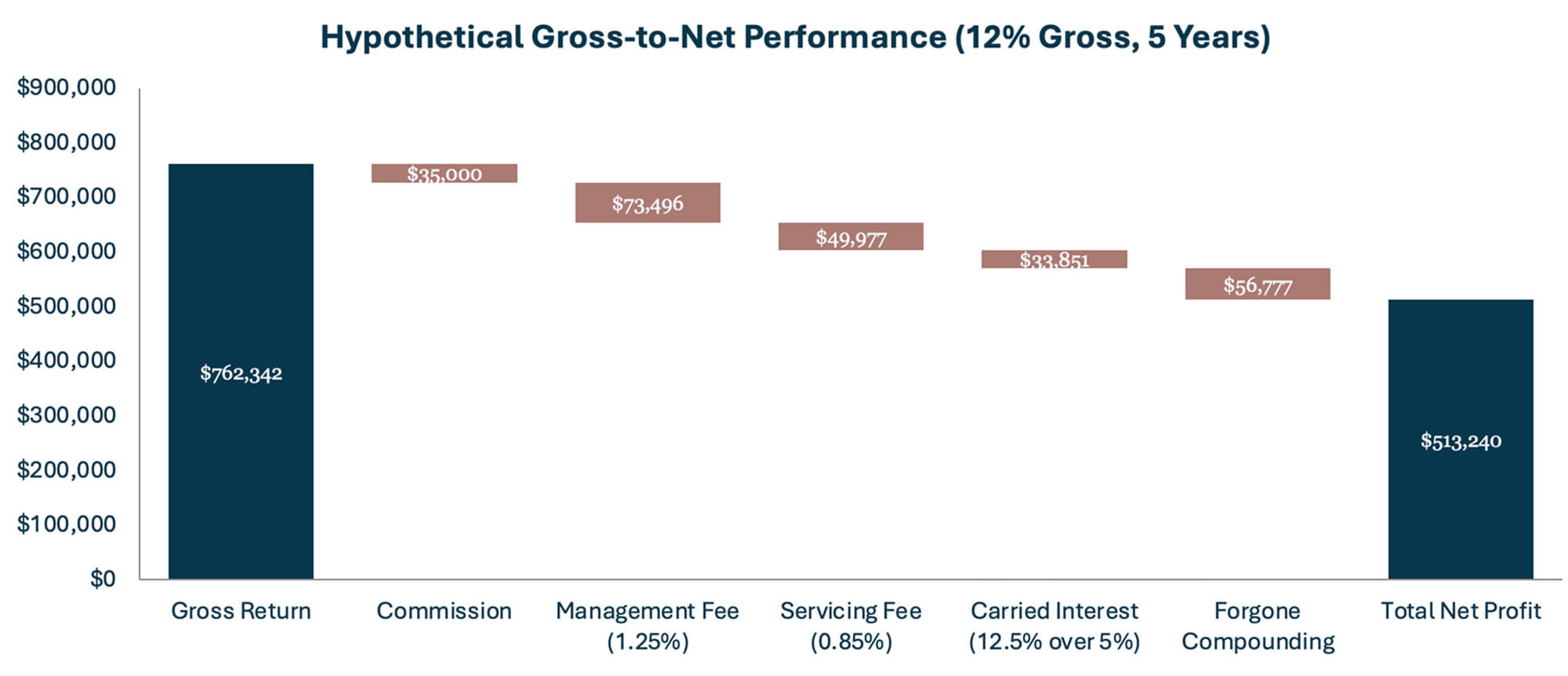
The fund worked. The hypothetical client still gave up nearly $250,000 - and it would not vanish into the market. It would have been paid out to the advisor who recommended the fund and the firm standing behind them.
You can watch that dollar from both ends inside a single fund. The same Financial Times analysis referenced above compared the high- and low-fee share classes of identical vehicles - same portfolio, same manager, separated only by who was being paid - and, by no surprise, found exactly what the link predicts. In one large evergreen fund, the lowest-fee class returned about 9.3% a year since inception while a higher-fee class returned 8%; in another, 9.5% against 7.8%. Those gaps, 1.3% and 1.7% a year, were at least as wide as those at other managers. The fee that makes a product worth selling is, almost to the basis point, the return the client surrenders to own it.6
And because most of the fee is collected whether or not the fund delivers, the sales incentive never wavers. A manager may or may not beat the market next year, but the fee is charged either way, compounding against the client year after year.
The strangest part of this investing architecture is that almost none of the structure is hidden. It is legal, and it is disclosed —somewhere, in a document that almost no one (is meant to) read. But disclosure is not alignment. The rules generally require a firm to reveal a conflict, not to remove it; a conflict you have been told about is still a conflict.
It is also why clients should be wary of the word the industry now leans on hardest: access - to top managers, to private credit, to private real estate, to “what the endowments do.” Sometimes, that access is real and worth paying for. But access is not advantage. A product is not good because it is hard to buy, hard to value, or hard to exit; it is good only if what the client keeps, after every fee and tax and unit of risk, beats the simpler thing they could have owned instead - a far higher bar than“exclusive,” and one many products never have to clear.
At Baker Street, we take no commissions, no referral fees, no placement fees, and no payments from the managers we choose. We build no proprietary products. When a fund is appropriate, we seek to use the lowest-cost option available to the client, and we seek to weigh every recommendation on return, risk, fees, and taxes together — the only figure that actually reaches the client. We have one primary source of revenue, the fees clients pay us, so our earnings do not move when a client buys one product instead of another: We are not paid more to recommend the complicated answer, not paid by managers to place client capital, and not filling a shelf that has to be filled. There is no shelf. For more details on how we construct portfolio allocations, read: 2026 Capital Market Assumptions Update | Baker Street Advisors.
Our business model does not eliminate judgment; it is designed to clear away the incentive to tilt it. Before recommending anything expensive, we ask a short, blunt set of questions:
Wealth management, from our perspective, has spent the past decade discovering two things at once. The first, from Part 1 of our series, is that firms can buy growth by buying other firms; the second is that distribution itself - moving a product into a client’s portfolio - can be one of the most profitable products a firm sells. When those incentives stack, the client’s task is not to panic but to pay attention because the return a portfolio earns and the return a client keeps are two different numbers, and the distance between them is where much of this industry makes its living.
Independence is worth the most precisely because of this: when the product is complex, the value is hard to verify, the exit is uncertain, and the fees arrive in layers.
Show us the incentive, and we will show you the outcome.
Disclaimers
Baker Street Advisors, LLC (“Baker Street”) is an investment adviser registered with the U.S. Securities and Exchange Commission. Registration as an investment adviser does not imply any particular level of skill or training. This material is provided for informational and educational purposes only and reflects the views of Baker Street as of the date published, which are subject to change without notice.
The information contained herein is not intended to constitute, and should not be construed as, investment, tax, legal, accounting, estate planning, or other professional advice. It is not a recommendation or solicitation to buy, sell, hold, or otherwise transact in any security, investment product, strategy, structure, or financial instrument, nor is it an offer to provide advisory services. Readers should not rely on this material as the basis for any financial, investment, tax, legal, or estate planning decision. References to specific companies are for illustrative and educational purposes only and are not recommendations to buy, sell, or hold any security.
The planning concepts discussed, including concentrated stock, equity compensation, liquidity events, tender offers, secondary sales, tax-aware investment strategies, charitable planning, estate planning, diversification, borrowing, direct indexing, exchange funds, collars, long/short tax-loss harvesting, private investments, and other complex strategies, depend on each individual’s facts and circumstances. These strategies may involve material risks, costs, tax consequences, illiquidity, leverage, counterparty exposure, reduced flexibility, and other limitations. They may not be appropriate for all investors.
Any examples, hypotheticals, or references to potential strategies are provided solely for illustrative purposes and should not be interpreted as advice tailored to any individual investor. Actual results will vary. Assumptions, market conditions, tax laws, and individual circumstances may change, and such changes may materially affect the appropriateness or effectiveness of any strategy discussed. References to tax rates, exemption amounts, and statutory provisions reflect law in effect as of the date of preparation and are subject to change.
Third-party research and publications referenced herein are used with attribution for educational purposes; conclusions drawn are those of Baker Street Advisors. Past performance is not indicative of future results.No investment strategy can guarantee a profit, avoid a loss, or achieve any particular outcome.
Baker Street does not provide legal or tax advice. Readers should consult their own tax, legal, accounting, estate planning, and other professional advisors before implementing any strategy or making any financial decision. Additional information about Baker Street, including its advisory services and fees, is available in its Form ADV, which is available upon request or through the SEC’s Investment Adviser Public Disclosure website.
Notes
1. Antoine Gara, “Wealth Advisers Made More Than $2bn from Private Capital Fees,” Financial Times, April 18, 2026.
2. John Chalmers and Jonathan Reuter, “Is Conflicted Investment Advice Better than No Advice?” Journal of Financial Economics138, no. 2 (2020): 366–87 (earlier circulated as NBER Working Paper No. 18158,2012). The 0.90% average annual broker fee and the underperformance of broker-client portfolios relative to comparable target-date funds are reported therein.
3. Gara, “PrivateCapital Fees.” Analysis of sixteen semi-liquid private capital funds — finding more than $2 billion in servicing fees paid to advisers since 2017. The high-versus low-fee share-class return comparisons are drawn from the same analysis.
4. U.S. Securities and Exchange Commission settled orders against Wells Fargo Clearing Services LLC, Wells Fargo Advisors Financial Network LLC, and Merrill Lynch, Pierce, Fenner & Smith Inc. in January 2025. The firms paid $60 million combined to resolve findings concerning bank-deposit sweep programs whose yields, during periods of rising rates, ran as much as roughly four percentage points below reasonable alternatives. Settled without admitting or denying the findings.
5. Illustrative calculation for a representative private fund of the kind sold to private wealth clients. Assumes a $1,000,000 investment earning a 12% annualized gross return over five years, bearing a 3.5% up-front commission, a 1.25% annual management fee, a 0.85% annual servicing fee, and 12.5% carried interest on profits above a 5% hurdle. Under these assumptions, the client’s net take-home return would be reduced by approximately $249,000 — roughly $192,000 in fees and $57,000 in compounding forgone on those fees — leaving net profit of about $513,000, close to two-thirds of the gross return.
6. Gara, “Private Capital Fees.”


